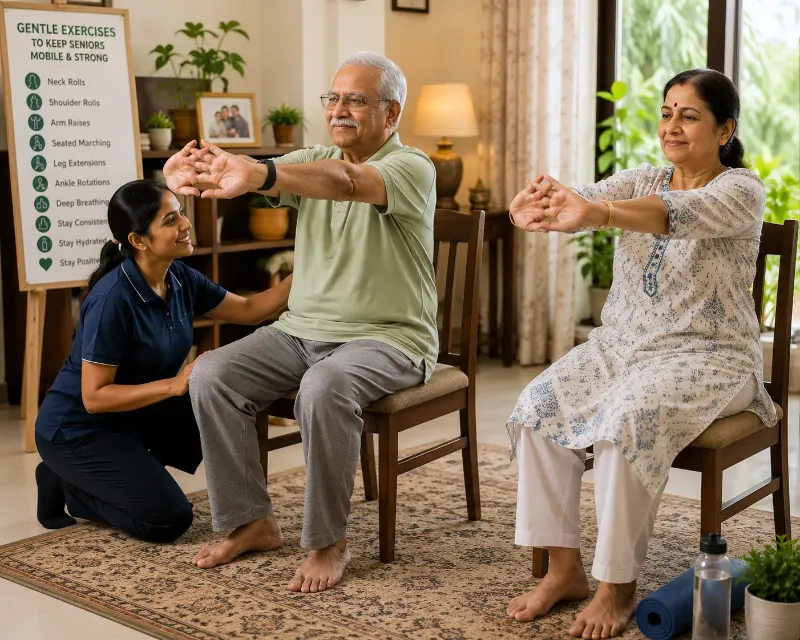
Strength doesn't disappear overnight. It fades gradually — a little every week that someone sits more than they move — until one day getting up from a chair requires a visible effort, or climbing stairs becomes something to plan around rather than just do.
The process reverses, also gradually. Consistent, gentle movement builds strength back. And for older adults, the gains aren't only physical — regular exercise is one of the most consistently evidence-backed interventions for mood, sleep quality and cognitive function.
Balance is the first thing to work on because falls are the biggest threat to independence. Stand behind a sturdy chair and hold the back lightly for support. Rise onto your toes, hold for 3 seconds, lower. Do 10 repetitions. Then try standing on one leg for 10 seconds — chair nearby — alternating sides. Do this once a day, every day. Within a few weeks, improvement is usually noticeable.
Sit toward the front of a firm chair with feet flat on the floor. Slowly straighten one knee, hold for 3 seconds, lower. Alternate legs, 10 repetitions each. This strengthens the quadriceps — the muscles most directly responsible for getting up from chairs, climbing stairs and walking safely.
For an added challenge: stand up from the chair slowly without using your hands to push off. If that's not possible yet, use your hands to assist and work toward doing it with less support over time. This single exercise — sit to stand — is one of the best predictors of functional independence in older adults.
While seated, extend both arms out to the sides at shoulder height and make small circles, gradually increasing the size. Do 10 in each direction. Follow with shoulder rolls (forward and back) and gentle neck rolls. These exercises maintain shoulder mobility and counteract the rounded-forward posture that tends to develop with age and extended sitting.
A 20-minute walk every morning is worth more than almost any other single intervention for an older adult's overall health. It works the legs and cardiovascular system, provides morning light (which regulates sleep), and — in most Indian neighbourhoods — provides social contact. The pace matters less than the consistency.
If knee or hip pain makes walking difficult, don't simply stop moving because it hurts — that usually makes things worse over time. A physiotherapist can assess what's actually causing the pain and suggest modifications or alternatives. Water walking, chair exercise, or cycle-based movement may be appropriate depending on the cause.
On yoga: Many traditional yoga postures are excellent for older adults — seated forward bends, gentle twists, pranayama breathing exercises. Headstands, deep backbends, and extreme forward folds are generally not appropriate for people with osteoporosis, spinal issues or compromised balance. A yoga teacher with specific experience with seniors makes a real difference.
Some muscle fatigue after exercise is normal and expected. Sharp or grinding pain in a joint is not — stop and get it evaluated before continuing. Exercises should feel like effort, not like something is wrong.
If your parent has had a recent fall, a fracture, a stroke, or is recovering from surgery, exercises should be guided by a physiotherapist rather than self-directed — the right exercises in the right sequence make a significant difference to outcomes.
HomeCarePro physiotherapists visit at home across Gurgaon for rehabilitation, stroke recovery and mobility improvement. Book a physiotherapy session →
Our team is ready to help your family — a free callback is just one tap away.