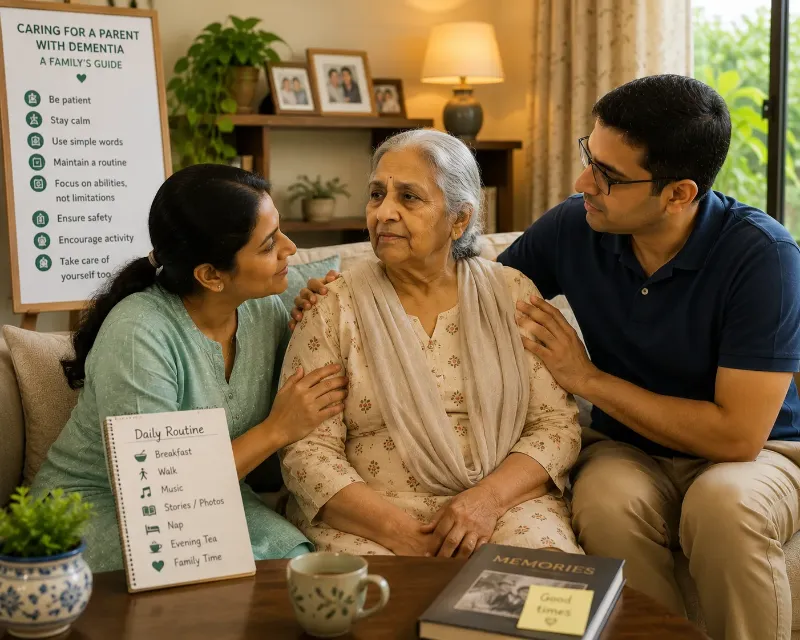
There's a moment in many families when forgetfulness tips into something that feels different. The same story told three times in an hour. Getting lost on a familiar route. Struggling to recognise someone they've known for decades. The word for what they're looking for simply gone.
Dementia is a progressive neurological condition — not a normal part of ageing, though it becomes more common with age. Understanding that distinction changes how you care for someone. You stop arguing them back to reality. You start building a world that works with the brain as it is, not as it was.
People with dementia rely on routine in ways that are difficult to overstate. The same wake time, the same breakfast, the same sequence of morning activities — these create a predictable, manageable world in a mind where unpredictability is frightening and exhausting. When routine is disrupted (visitors who arrive and leave, a trip to the doctor, a family gathering), behaviour often worsens — more confusion, more agitation. This isn't stubbornness; it's how the condition works.
Build the day around consistent anchors. Morning chai at the same time. A walk or a sit in the sun at the same time. Meals at fixed times. The specific activities matter less than the consistency of the structure.
Speak slowly, in short sentences, with one idea at a time. Avoid questions that require recall — "Did you eat breakfast?" is harder to answer than "It's time for breakfast." Use names rather than pronouns: "Amma, come sit here with me" is clearer and more grounding than "Come here."
Don't argue with false memories or incorrect beliefs. If your parent insists it's 1985 and they need to get to work, correcting them adds distress without helping them. Gentle redirection — "Let's have chai first and then we'll sort that out" — is almost always more effective.
Stay calm in your voice even when the situation is not calm. Agitation is contagious; so is calm. People with dementia often lose access to words before they lose the ability to read emotional tone.
Many people with dementia become significantly more confused, anxious or agitated in the late afternoon and early evening — a phenomenon called sundowning. The causes are not fully understood, but fatigue accumulating across the day, decreasing natural light and the disruption of evening transitions all play a role.
What tends to help: keeping late afternoons low-stimulation and calm; ensuring the person gets morning light and some physical activity earlier in the day; reducing caffeine after noon; using bright indoor lighting in the late afternoon (dim light seems to worsen confusion); maintaining the evening routine very consistently.
As dementia progresses, the home needs to adapt. Door alarms so you know if someone leaves unsafely at night. Locks on the medicine cabinet — medication errors are a serious risk. The stove may eventually need to be disabled if it is being left on unsafely. A GPS tracker on a watch or phone for someone who wanders.
Falls risk increases as the condition progresses. The home safety measures in our earlier article on senior-proofing become increasingly important at this stage.
Caregiver grief is real — grief for the person your parent was, for the relationship you had, for conversations that are no longer possible. This grief exists alongside the person still being physically present, which makes it particularly disorienting. You are allowed to find this hard.
Respite care — a trained attendant for a few hours so you can sleep, or a planned break that allows you to recover — is not abandonment. It is what allows family members to sustain care over what may be a period of years without burning out.
Getting a diagnosis: Dementia is a medical diagnosis, not something to be managed on observation alone. A neurologist or geriatrician can assess cognitive function, identify the type of dementia (Alzheimer's, vascular, Lewy body and others require different approaches), rule out treatable causes of cognitive decline, and advise on medications that may slow progression.
HomeCarePro provides trained caregivers experienced in dementia care, available as daily support or live-in attendants across Gurgaon. Talk to our team →
Our team is ready to help your family — a free callback is just one tap away.